Run your NDIS business on the software we run ours on.
Rostering, SCHADS-aware payroll, NDIS billing and compliance in one platform — built by a registered Melbourne provider and tested on our own pay runs before it ever reached yours.
We run our own NDIS provider on RosterRoo.
One shift, from the roster to the invoice
Rostered, worked, written up, approved, paid and billed. Follow a shift through RosterRoo, one real screen at a time.
- 01
Rostered.
The week, for every participant
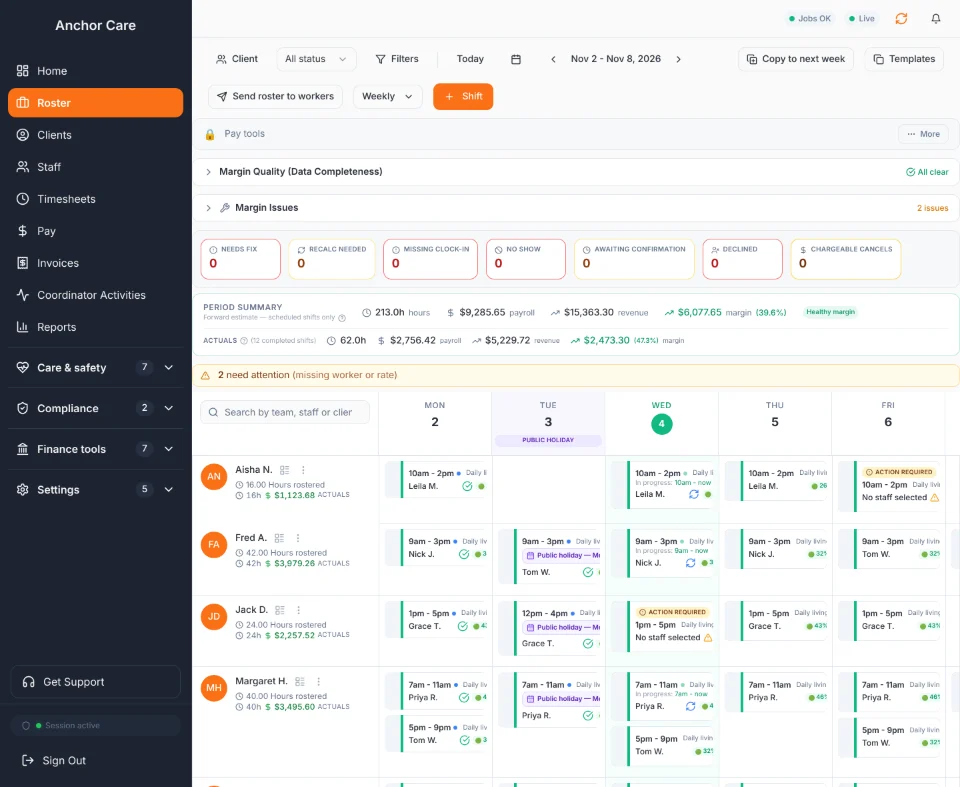
Shifts sit against the participant and the worker, with live status as the day runs — in progress, completed, or flagged because nobody is on it yet. When the week is ready, send it to your workers in one go.
app.rosterroo.com.au - 02
On shift.
One app for support workers
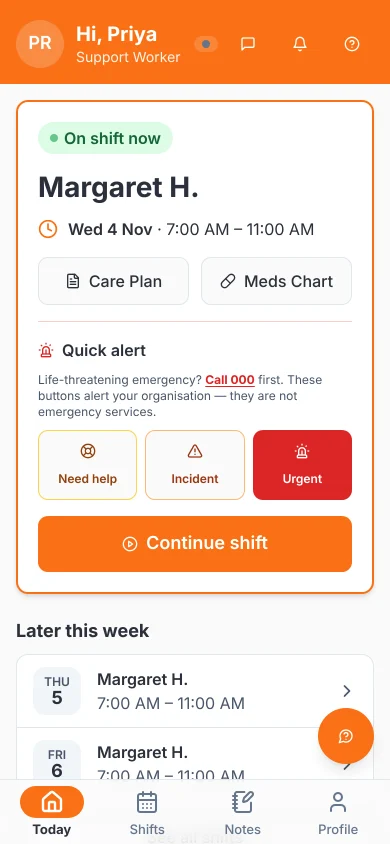
Support workers get one app: see your shifts, clock in and out with GPS verification, write your notes, submit expenses. It tolerates dead spots and dying batteries, because support work doesn't happen next to good wifi.
- 03
Noted.
Case notes, hour by hour
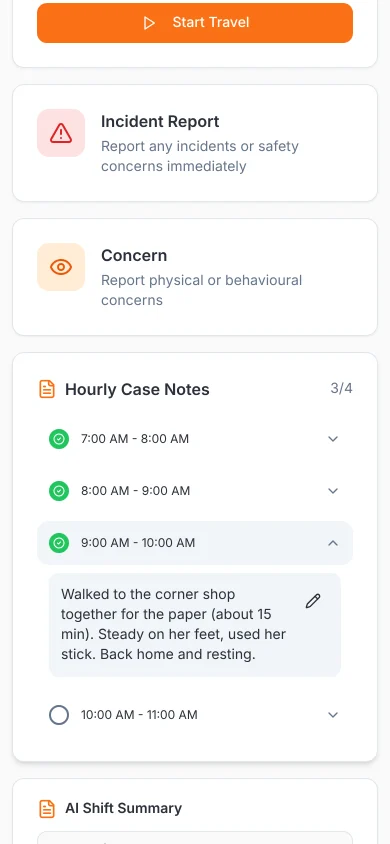
Documentation captured during the shift, not reconstructed later — and case notes screened for concerns as they're written.
- 04
Approved.
Clock-ins become timesheets
Clock-in and clock-out times arrive as timesheets against the rostered shift, with late starts marked. Approve them one at a time or in a batch.
- 05
Paid.
Payroll that finishes here
PAYG from current ATO tax tables, ABA bank files your bank accepts, and RCTIs for contractors — generated in the platform, not exported to a second system to finish. One pipeline from timesheet to paid.
- 06
Invoiced.
Costed twice, because pay and billing are not the same sum
What you bill a plan and what you owe a worker are different calculations, and a system that computes one and reuses it for the other is quietly wrong on exactly the shifts where it matters — the ones crossing midnight, weekends and public holidays. RosterRoo computes and stores them separately, per shift, server-side, so the roster shows you both before you commit to it.
What's actually different
Funding-period release tracking
Since May 2025, NDIS plans release funding in instalments — and no portal shows providers the schedule. RosterRoo tracks released-to-date against claimed, per plan, so you see a claim that would outrun released funds before the agency bounces it.
Compliance in the workflow, not a binder
Incident reports, restrictive-practice records, case notes screened for concerns as they're written, service agreements with e-signature — captured where the work happens, so audit evidence is a by-product of operating, not a separate job.
Award rates you can point at
The current-year SCHADS rate ladder is harvested and held per classification level, and the platform only serves a rate it can verify for that level and employment basis. If a level can't be verified, it fails closed and says so rather than quietly serving a stale number — because “probably still current” is not a thing you want under a pay run.
Your data is stored in Australia
RosterRoo data — participant records, case notes, payroll, documents — is stored in the AWS Sydney region (ap-southeast-2): database, file storage and backups. Features that use AI (case-note checks, drafting care plans and incident reports, reading uploaded documents, voice-to-text) send the text or file they work on to our AI providers, which may process it outside Australia. Our Privacy Policy lists them.
Free NDIS budget calculator: see what's released and what you can spend each week
Enter plan dates and funding. It shows the funding released per period, what's available now, and a safe weekly amount to the next release and to plan end. No sign-up, and your figures stay in your browser.
AI for NDIS rostering and compliance work — what it should and shouldn't do
Most "AI for NDIS" is a chatbot bolted onto a form. Ours does the unglamorous jobs: it reads what your support workers actually type while they are still typing it, it checks its own output before you see it, and where it wants to change something it asks first.
Case notes are screened before they save. Two passes run on the worker's own text — a deterministic keyword check that understands negation, and a model that reads the note in context and catches the phrasings nobody thought to put on a list. If a note describes something that looks like an incident while the incident question says "none observed", the worker is asked about it there and then, not at the next file review.
It reads what the worker wrote, not a tidied-up summary of it. That ordering matters: a paraphrase drops exactly the detail a screen is looking for.
And it fails open, on purpose. Dead spot, flat battery, edge function down — the note still saves and the keyword pass still runs. Blocking a worker from recording what happened because a network call failed would be a worse outcome than a missed flag.
It checks its own drafts. The care plan generator is asked to quote a participant's documented words where the source allows — and then a deterministic check looks for every quoted span, verbatim, in the documents actually supplied. Anything it cannot find is demoted to plain text and marked for you to verify. Marking only: nothing is rewritten, nothing is deleted, nothing passes silently.
It hands back what it cannot do. A worker photographing a receipt gets the details read off it and filled in. When the image cannot be read, they are told so and asked to enter it manually — no silent partial fill, no confident number pulled out of a blurred total.
And it is switched off where consistency matters more than novelty. Worker training runs from fixed, authored curriculum, served the same way to every worker every time. Compliance training has to be the same thing twice; a module that regenerates is a module that can quietly change what your workers were taught.
What it does not do: act on its own. Where the system can propose a fix, it doesn't apply it — it queues it. The proposal sits as pending until a person approves or rejects it, and only an approved action can execute. The executor checks that approval before it runs anything, routes through safe handlers, and never writes to financial records directly.
That last constraint is the one worth knowing: the category of record where a wrong automated write costs the most is the category it is structurally not allowed to touch. In this sector the accountable decision belongs to a person, and software that quietly takes it isn't saving you work — it's moving your risk somewhere you can't see it.
$19.95 per worker per month + GST
$21.95 including GST, for each active support worker. Flat. Everything on this page is included — no tiers, no feature gates, no setup fees, no per-participant charges, no lock-in. The trial is 7 days and doesn't ask for a card.
Frequently asked questions
Is RosterRoo specifically designed for NDIS providers?
How does the mobile app work for support workers?
Can RosterRoo handle overnight and cross-day shifts?
Is my data secure?
How long does it take to get started?
Can I try RosterRoo before committing?
Still have questions? Get in touch
Have Questions?
Our team is here to help. Send us a message and we'll get back to you within 1-2 business days.
Quick Response
We respond to all enquiries within 1-2 business days.
NDIS Experts
Our team has hands-on NDIS provider experience.
Free Demo
Request a personalised walkthrough of the platform.
Prefer to chat live? Schedule a free 15-minute demo call with our team.